

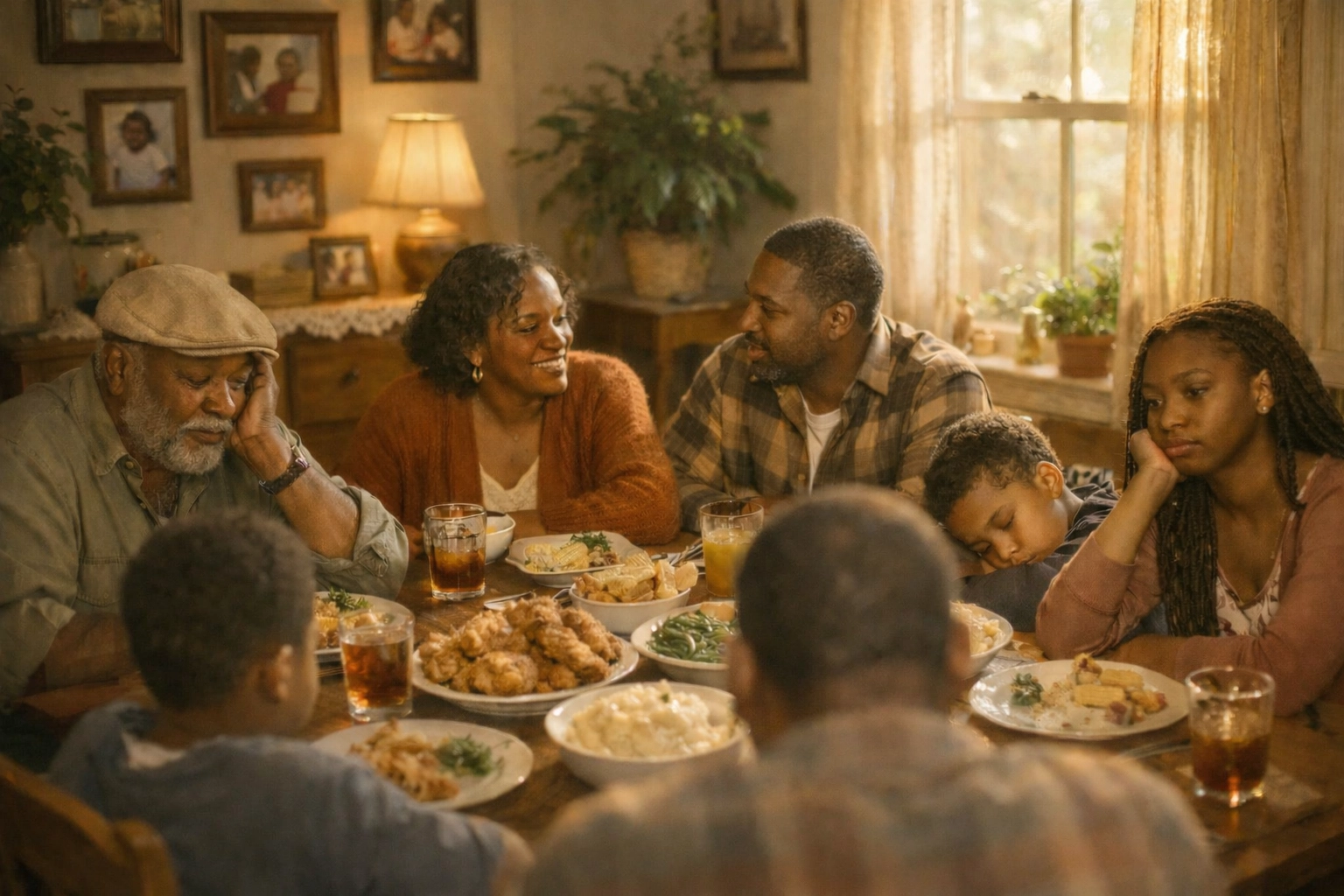
"It takes a village to raise a child." You've heard it a thousand times. For many BIPOC families, this isn't just a saying, it's a way of life, a cultural value passed down through generations. But what happens when that village starts feeling less like support and more like an obligation that's pulling your household apart?
Let's talk about something that doesn't get enough airtime in therapy circles: the real tension between honoring your community and protecting your home.
The Cultural Weight of Community
In Black, Indigenous, and communities of color, the concept of collective responsibility runs deep. It's rooted in survival, in history, in the understanding that we've always needed each other to make it through. Your aunt who needs help with bills. Your cousin's kids who need somewhere to stay. Your grandmother who expects Sunday dinners. The friend from church who just got out of rehab and needs support.
These aren't just requests, they're expectations woven into the fabric of what it means to be family, to be part of your community.
And here's the thing: these obligations are beautiful. They're what kept our ancestors alive. They're what built resilience in communities that faced systemic oppression. The problem isn't the village itself, it's when the village becomes a burden that your nuclear family can't sustain.
When "Yes" Becomes a Breaking Point
I've sat across from countless couples in my office at The Mind and Therapy Clinic who are fighting about the same core issue disguised in different scenarios:
Her perspective: "Your mama is always here. We can never just be us. Every time we plan something, someone in your family needs something, and you drop everything."
His perspective: "That's my family. What am I supposed to do, turn my back on them? You knew how close we were when we got together."
Sound familiar?
The division isn't really about whether Mama can come over or whether your brother can borrow money. It's about competing values, unspoken expectations, and the exhaustion of never feeling like your own household comes first.
The Hidden Divisions That Destroy Homes
Let's break down what's really happening when community obligations clash with home harmony:
Financial Strain: When extended family regularly needs financial help, it creates resentment, especially when one partner feels like they're working hard only to support people who aren't contributing to your household goals. The dream of buying a house gets pushed back another year because someone else's emergency became your priority. Again.
Time and Energy Depletion: You're already juggling work, kids, and trying to maintain your relationship. Add in daily calls from family members with drama, weekend obligations to help someone move, or being the default babysitter for nieces and nephews, and suddenly there's nothing left for your partner or your own children.
Boundary Violations: When extended family has keys to your house and shows up unannounced, when they discipline your children differently than you've agreed upon, when they share your personal business with the whole family, these boundary violations chip away at the foundation of your home.
Cultural Guilt and Manipulation: The most painful part? The guilt. Being called selfish for wanting boundaries. Being accused of "acting white" or "forgetting where you came from" when you prioritize your nuclear family. Having elders weaponize respect and cultural values to override your needs as a couple.

What the Research Actually Says
Studies on multigenerational BIPOC families consistently show that while extended family support systems provide crucial emotional and practical resources, especially in communities facing systemic barriers, they can also create significant stress when boundaries aren't clear.
Research published in the Journal of Family Psychology found that couples who reported high levels of extended family involvement without clear boundaries also reported lower marital satisfaction and higher conflict rates. The key factor? Mutually agreed-upon boundaries and shared decision-making between partners.
Here's what matters: It's not about choosing between your culture and your marriage. It's about creating a framework where both can exist without destroying each other.
The Three-Part Framework for Balance
After working with BIPOC couples for years, I've seen what actually works. It's not about cutting people off or becoming isolated. It's about creating intentional structure.
Part 1: Get Clear on Your Non-Negotiables
Sit down with your partner, just the two of you, and identify your core needs as a nuclear family. What does your household require to function and thrive? This might include:
- A minimum amount of couple time each week
- Financial boundaries (how much you can give without compromising your goals)
- Physical boundaries (who has access to your home and when)
- Decision-making authority (who gets final say on your children, your schedule, your money)
Write these down. These are your foundation.
Part 2: Honor the Village, Establish the Structure
Here's the empowering truth: You can honor your culture AND protect your home. You just need to be strategic about it.
Instead of saying yes to every request, create sustainable ways to contribute:
- Set a specific dollar amount you can give to extended family monthly, and stick to it
- Designate specific days/times for family obligations (Sunday dinners, yes; Thursday night emergencies, not so much)
- Create a rotating system among siblings for elder care or family responsibilities
- Be willing to help with your time OR your money, but not always both
Part 3: Communicate with Compassion and Clarity
This is where most couples struggle. One partner wants to set boundaries but doesn't know how to communicate them without being seen as disrespectful. The other partner feels caught between family loyalty and relationship needs.
Practice saying: "I love you, and I want to help. Here's what I can do right now." Full stop. No over-explaining. No guilt-ridden justifications.
When family pushes back (and they will), hold firm: "I hear you, and I understand you're disappointed. This is what works for our household right now."

The Couples Work: Getting on the Same Page
The biggest mistake I see? Couples trying to manage these issues individually instead of as a team. You're fighting each other instead of tackling the problem together.
Here's what needs to happen:
Create a United Front: Before any family interaction or request, check in with your partner. "What do you think about this?" Don't make unilateral decisions about time, money, or boundaries that affect your household.
Validate Both Perspectives: If one partner comes from a culture of intense family enmeshment and the other doesn't, both experiences are valid. The goal isn't to convince anyone they're wrong: it's to find middle ground you can both live with.
Address the Deeper Wounds: Often, the resistance to boundaries comes from unhealed trauma. Fear of abandonment. Guilt about having more than other family members. Generational trauma about survival. These need therapeutic attention, not just logical problem-solving.
As a Licensed Professional Counselor Supervisor, I work with couples to unpack these layers so they can make conscious choices instead of reactive ones.
When It's Time to Get Professional Support
You need professional help when:
- Arguments about family obligations are constant and escalating
- One or both partners feel resentful, exhausted, or trapped
- Financial stress from family obligations is creating crisis in your home
- Children are being affected by adult family drama or boundary violations
- You've tried setting boundaries, but guilt or manipulation keeps breaking them down
- Cultural values feel like they're being used to control rather than connect
These aren't signs of weakness: they're signs that the patterns are bigger than what you can address alone.
Building a Village That Supports, Not Depletes
The goal isn't isolation. The goal is sustainability. A healthy village should make your family stronger, not tear it apart.
This means:
- Extended family respects that your nuclear family is your priority
- Obligations go both ways: contribution, not just taking
- Boundaries are honored, not guilt-tripped
- Support is offered without strings or expectations of control
- Cultural values are used to build up, not manipulate
Your Next Step
If you're reading this and seeing your relationship in these words, you're not alone. This is one of the most common issues facing BIPOC couples, and it's one of the most under-discussed.
Start with one conversation with your partner: "Can we talk about how we're both feeling about family obligations? I want us to be on the same team."
That's it. Just start there.
Posted in: Counseling, Therapy
Tags: BIPOC relationships, family boundaries, couples therapy, cultural expectations, relationship conflict
Need Support?
At The Mind and Therapy Clinic, we specialize in helping BIPOC couples navigate these complex family dynamics. Located in Texas, we provide culturally responsive therapy that honors your background while helping you build the healthy boundaries your relationship needs.
Contact us at mindandtherapyclinic.com to schedule a consultation.
Leave a Comment
How do you balance family obligations with your relationship needs? Share your experiences below.
Subscribe to Our Newsletter
Get practical relationship insights delivered to your inbox monthly. Real talk for real relationships.