
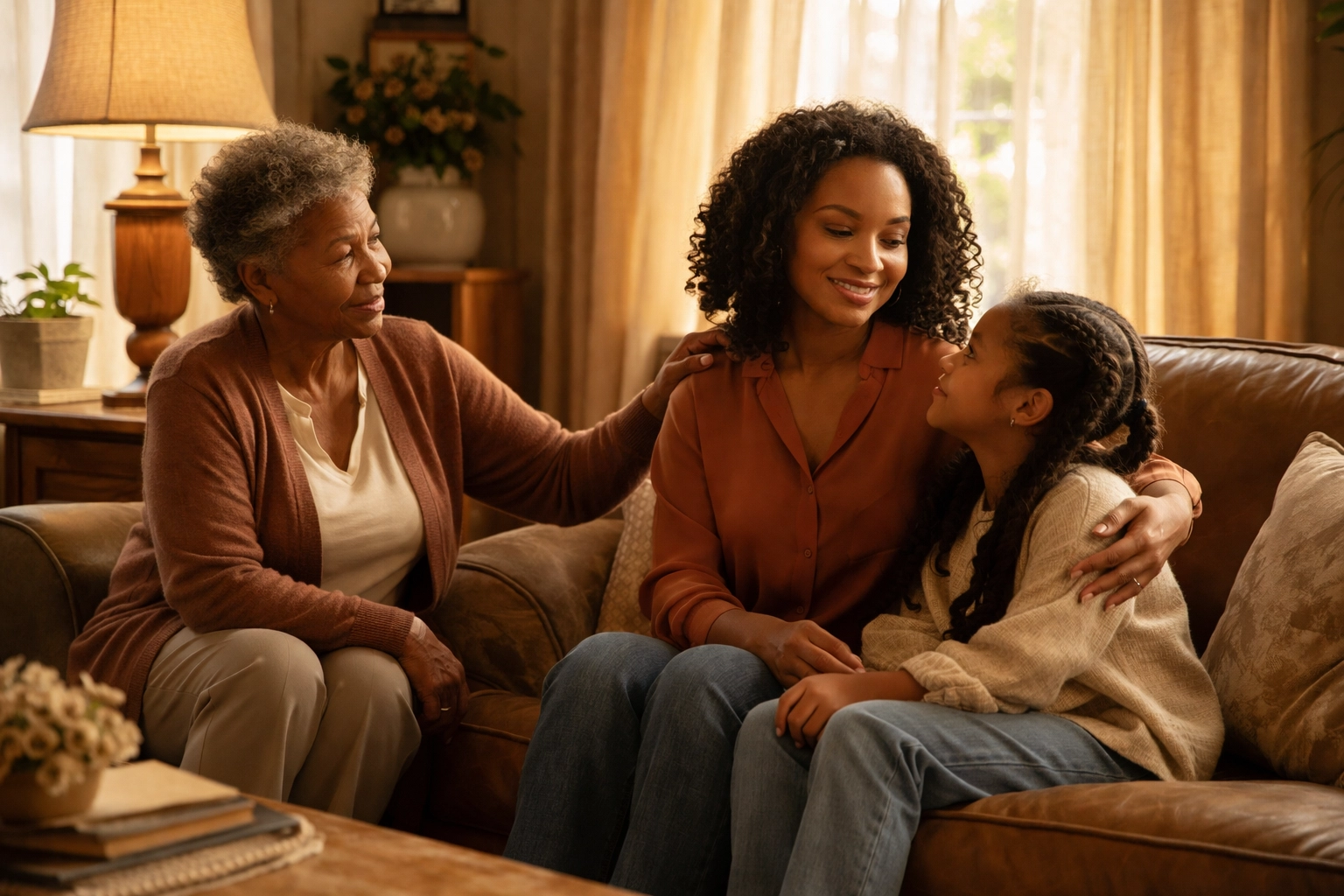
Every family carries a story. Some of those stories are spoken at dinner tables and reunions. Others live in the silences, the unspoken rules, and the ways we learned to love, or protect ourselves from love. For many Black families, these inherited patterns run deep, shaped by generations of resilience, survival, and adaptation to circumstances that were often beyond our control.
But here is the good news: cycles can be broken. Patterns can be rewritten. And the work you do today can transform not only your relationships but the legacy you pass on to future generations.
Understanding Generational Relationship Patterns
Generational relationship patterns are essentially emotional blueprints passed down through families. They shape how we handle love, communication, conflict, and intimacy. These patterns are not always taught directly. Often, they are absorbed through observation, watching how your parents argued, how affection was shown (or withheld), and how emotions were processed in your household.
For Black families specifically, these patterns are often intertwined with historical trauma and community trauma. The effects of systemic oppression, economic hardship, and the need for emotional armor in hostile environments have all contributed to relationship dynamics that, while once necessary for survival, may no longer serve us in building healthy, connected partnerships.
Common inherited patterns in relationships include:
- Emotional suppression – Learning that vulnerability is weakness
- Conflict avoidance – Believing that keeping the peace means staying silent
- Hyperindependence – Refusing to rely on others because trust was broken early
- Communication through criticism – Expressing care through correction rather than affirmation
- Prioritizing achievement over presence – Measuring love through provision rather than emotional availability
These adaptations made sense in their original context. They helped our ancestors and parents survive. However, when carried into modern relationships without examination, they can create distance, resentment, and disconnection.
The Quiet Inheritance: What You Did Not Receive
Much of generational healing focuses on traumatic events, the things that happened. But equally important is examining what was missing. Did you grow up in a home where warmth was freely given? Was emotional safety a guarantee? Did you witness healthy conflict resolution between your caregivers?
For many, the answer to these questions is complicated. You may have been loved deeply, yet still missed crucial elements of emotional nurturing. This is not about blame. It is about awareness.

When we do not receive what we need emotionally, we adapt. We may become people-pleasers, perfectionists, or emotional walls. We may choose partners who feel familiar, not because they are healthy for us, but because their patterns match the unresolved wounds we carry.
Recognizing these gaps is the first step toward filling them intentionally in your current relationships.
How These Patterns Show Up in Black Relationships
Black love is powerful, resilient, and deeply rooted in community and commitment. Yet it is also shaped by unique pressures that can activate generational patterns in unexpected ways.
Consider these scenarios:
- The partner who shuts down during arguments may have learned that expressing emotions led to punishment or dismissal in their childhood home.
- The spouse who works constantly may be operating from a generational belief that provision equals love, even at the expense of presence.
- The person who struggles with jealousy or control may be responding to inherited fears of abandonment or betrayal.
These are not character flaws. They are protective strategies developed in response to earlier pain. When both partners in a relationship carry their own set of inherited patterns, conflicts can escalate quickly, not because of the present issue, but because of the past wounds being triggered.
The Path to Healing: Practical Steps
Breaking generational cycles requires intentional effort. Here are concrete steps to begin the healing process:
1. Develop Self-Awareness
Start by examining your own patterns. Ask yourself:
- How did my parents handle conflict?
- What did I learn about expressing emotions growing up?
- What relationship behaviors do I repeat even when they do not serve me?
Journaling, meditation, and honest self-reflection are valuable tools in this process.
2. Understand Your Attachment Style
Your attachment style, formed in early childhood, significantly impacts how you relate to romantic partners. Understanding whether you lean toward anxious, avoidant, or secure attachment can illuminate why certain relationship dynamics feel familiar or triggering.

3. Practice Vulnerability in Safe Spaces
Healing requires vulnerability, but vulnerability requires safety. Begin practicing openness with people who have earned your trust. This might be a close friend, a support group, or a therapist who understands the nuances of Black relationships and generational trauma.
4. Set Boundaries Without Guilt
Many generational patterns involve porous or rigid boundaries. Learning to set healthy boundaries, saying no without excessive guilt, protecting your peace without cutting off connection: is essential for breaking cycles.
5. Communicate Your Needs Clearly
Unspoken expectations lead to unmet needs. Practice articulating what you need from your partner directly and compassionately. This may feel uncomfortable if your family operated on assumptions rather than open communication, but it is a skill that can be developed.
6. Seek Professional Support
While personal reflection creates a foundation, breaking generational cycles often requires more than self-reflection alone. Working with a therapist who specializes in trauma and relationship dynamics provides tools and structure to process inherited pain and reshape behavior.
Approaches that can be particularly helpful include:
- Somatic practices like breathwork and EMDR to release patterns stored in the body
- Attachment-based therapy to understand and shift relational patterns
- Couples therapy to explore how each partner's protective strategies interact
- Culturally informed counseling that honors the specific experiences of Black individuals and families
Healing Together: Breaking Cycles as a Couple
When two people commit to healing together, the impact multiplies. Couples who address generational patterns together often experience:
- Stronger emotional boundaries
- Improved communication during conflict
- Greater capacity for trust and intimacy
- Reduced anxiety and emotional reactivity
- A shared sense of purpose in building a healthier legacy

The key is approaching this work as partners rather than adversaries. When your partner's behavior triggers you, ask: "What wound is this touching?" When conflict arises, pause and consider: "Are we fighting about this moment, or about something older?"
This perspective does not excuse harmful behavior. It contextualizes it in a way that opens doors for understanding, repair, and growth.
The Bigger Picture: Healing for Generations
Perhaps the most powerful motivation for breaking generational cycles is understanding that this work extends beyond yourself. When you heal, you interrupt patterns that may have been running for generations. You create new possibilities for your children, your nieces and nephews, and your community.
You are not just healing for yourself. You are healing for the generations before you who did not have the resources or opportunity to do this work. And you are healing for the generations yet to come, giving them a cleaner emotional slate to build upon.
Take the First Step Today
Breaking generational patterns is not easy work. It requires courage, consistency, and often professional guidance. But it is possible. And it is worth it.
If you are ready to begin this journey: whether individually or as a couple: we invite you to reach out. At The Mind and Therapy Clinic, we specialize in helping individuals and couples navigate trauma, relationship challenges, and the path toward healing.
Your history does not have to be your destiny. The cycle can end with you.
Ready to start your healing journey? Contact us to schedule a consultation and learn how therapy can support you in building the relationships you deserve.
Posted in: Therapy, Trauma, Counseling